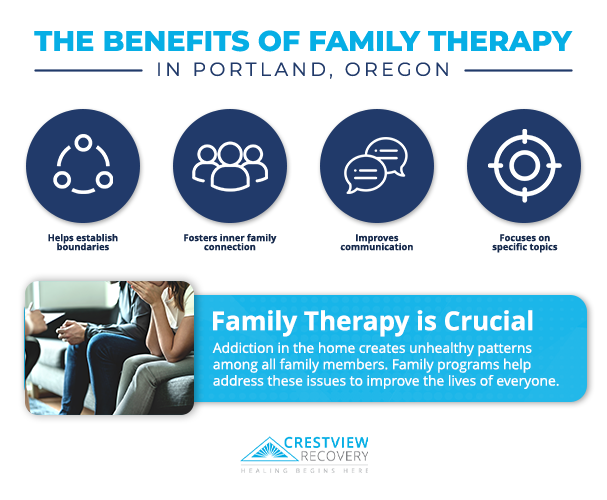
Addiction recovery requires a lot of help and support. For many of our clients at Crestview Recovery, the family can be the most powerful support network available. Involving family members in structured addiction therapy is an effective way to maintain sobriety, limit relapse, and help the people closest to you understand how to genuinely help without unintentionally making things harder.
At Crestview Recovery, we recognize that addiction affects more than the individual. It impacts the entire family, and everyone needs a chance to heal. Our family therapy services are facilitated by licensed therapists and are available across our addiction treatment programs, from residential treatment to outpatient care.

Healing Begins Here

Types of Family Therapy Available
Some married or partnered patients participate in addiction therapy with their spouse or partner. This helps strengthen the relationship and teaches the sober partner how to provide meaningful support without enabling. Enrolling in a residential treatment program or attending a treatment center can reinforce these healthy dynamics between sessions.
For young adults and others with close family ties, parents, siblings, or other close relatives are invited to attend family therapy sessions. Involving the whole family brings together a small community of support and accountability around the person in treatment.
In some cases, family sessions do not include the patient. Family members may meet with a therapist alongside others in similar situations, a space to share their own fears and concerns without those in the throes of addiction overhearing or feeling judged. Recovery can be just as hard on loved ones, and they deserve access to quality mental health support as well.
Using Therapy to Educate Family Members About Addiction
One of the core goals of family-based therapy is to teach participants how addiction develops: neurologically, psychologically, and socially. Family therapy reinforces that addiction is a disease, not a moral failing. When family members internalize this, they often find that their fear and frustration shift toward understanding and compassion, creating a much more effective support environment at home.
Drawing the Line Between Helping and Enabling
Enabling is any behavior that, despite good intentions, allows a person to avoid the natural consequences of their addiction, which in turn reduces their motivation to seek or sustain recovery. Common examples include:
- Picking a family member up from treatment before they have completed the program
- Covering for their behavior with employers, friends, or other family members
- Providing money that is likely to be used to fund substance use
- Minimizing or dismissing the severity of the problem to keep the peace
Through therapy, family members learn that the most loving thing they can do is allow the recovery process to unfold, which sometimes means stepping back rather than stepping in. This is not abandonment; it is a form of support that respects the person’s ability to do the hard work of recovery.
Family therapy helps loved ones identify their own enabling patterns in a safe, non-judgmental space and practice healthier responses with the guidance of a licensed therapist.

How to Help a Family Member Struggling with Addiction
Al-Anon and Nar-Anon are free, community-based peer support groups specifically for family members and friends of people with alcohol or drug addiction. They operate on a 12-step model and offer ongoing, long-term support through shared experience.
These groups complement Crestview’s Family Program well. Many families find it helpful to participate in both: using our clinical program during the treatment period and Al-Anon or Nar-Anon for ongoing community support in the years that follow. Meetings are held throughout Portland and available in many online formats as well.
This is one of the most difficult boundaries to hold, especially for parents. Natural consequences, such as losing a job, facing legal trouble, or experiencing relationship strain, are often the very catalysts that motivate someone to seek and sustain treatment. Shielding your loved one from these consequences, even with the best intentions, can delay their readiness for change. Our addiction treatment services are designed to help both clients and families navigate this process with professional guidance.
Creating a substance-free environment when spending time with your loved one is one of the most concrete ways you can show your support. This is especially important in the early stages of recovery, when triggers are strongest, and the skills to manage them are still being developed.
It is nearly impossible to support someone else through recovery if you are running on empty. Your own mental and physical health matters. Crestview’s family-only therapy sessions, Al-Anon, individual therapy, and self-care practices are not indulgences. They are essential tools. If you are also managing your own mental health concerns, our mental health treatment programs can provide additional support alongside your loved one’s care. The better you do, the better you can show up for your loved one.
Family Therapy: Showing Patients They Are Not Alone
In family therapy sessions, family members have the opportunity to show up, literally and emotionally. This can go a long way in helping patients see that they have a built-in support network that wants to help them succeed. It also gives families a structured, therapist-facilitated space to begin rebuilding trust and communication patterns that may have broken down during the period of active addiction. It also gives families a structured, therapist-facilitated space to begin rebuilding trust and communication patterns that may have broken down during the period of active addiction. For many families, that involvement starts even earlier, with an addiction intervention Portland loved ones organize to help someone take the first step toward treatment.
Recovery is not just the client’s journey. It belongs to the whole family. Crestview Recovery’s family therapy program is here to support every person in that circle.
We Accept Most Insurance
In-network providers include:
- Moda
- Aetna
- Cigna
- Blue Cross Blue Shield
- Beacon Health Options
- Providence Health Plan
- PacificSource
- TriWest
- Kaiser Permanente
- GEHA
- First Choice Health
- Magellan
- MultiPlan
Verify your insurance online or call to speak with admissions about your coverage.
Family Therapy FAQ
Family therapy is strongly encouraged but not mandatory for all clients. For many people in treatment, involving family members significantly improves long-term recovery outcomes. Our clinical team will discuss family therapy options with each client during intake and assessment to determine the level of family involvement that is appropriate and beneficial.
Yes. Family therapy and the Family Program are available to clients across Crestview’s programs, not only those in residential treatment. If your family member is enrolled in PHP, IOP, or another outpatient level of care, our team can discuss how and when family involvement is most beneficial, given their current stage of treatment.
This is more common than many families expect, and it is not a reason to give up. Crestview offers sessions specifically for family members that do not include the client, a space where you can process your own feelings, share concerns with others in similar situations, and learn how to support recovery without enabling. You do not need to wait for your loved one to agree before beginning your own healing.
Coverage for family therapy varies by insurance plan. Crestview Recovery accepts most major insurance providers, and our admissions team can verify your benefits before sessions begin. We encourage family members to call us directly so we can walk you through what is covered under your specific plan.
Al-Anon and Nar-Anon are free, community-based peer support groups for family members and friends of people with addiction. They offer ongoing, long-term support through shared experience and the 12-step model. Crestview’s Family Therapy Program is a clinically facilitated, structured therapeutic experience led by licensed therapists as part of the formal treatment process. The two complement each other well, and many families benefit from participating in both.